No desire to become prime minister

No desire to become prime minister

While I was going through the Kathmandu Post of various dates,  I noticed an interesting article by Anil Giri published on February 14, 2020 about Pushpa Kamal Dahal aka Prachanda, Chairperson of Nepal Communist Party (CPM), I could not resist myself for sharing in my blog for my regular readers.

Without elaborating this article, I decided to summarize only the main events which are included in Anil Giri’s article.

  The chairman has an identity crisis

Pushpa Kamal Dahal is torn between his two selves: an insidious, crafty Prachanda who will go on the offensive to get what he wants, and a gentle, pragmatic Pushpa Kamal who can placate opposing factions and win over the media.

Pushpa Kamal Dahal is a man divided.

At the final session of Kantipur Conclave last week, Pushpa Kamal, dressed in a dark suit with a matching topi and a silk tie, appeared relaxed and confident, speaking at length about himself, his journey and his ambitions.

“I have no desire to become prime minister any time soon,” he said.

But Pushpa Kamal had only just put Prachanda to rest. In vying for power with co-chair and prime minister KP Sharma Oli, Prachanda had pulled off a Machiavellian feat, turning Oli’s former UML allies against him. Prachanda’s man, Agni Sapkota, became Speaker of the House of Representatives over Oli’s choice of Subas Nembang.

“He seized the offensive,” Lekhnath Poudel, a central committee member of the party told the Post on Sunday, describing Dahal’s tactics.

 Continue reading : https://kathmandupost.com/politics/2020/02/14/the-chairman-has-an-identity-crisis


Prachanda remains torn between becoming the consummate politician and remaining the quintessential commander. 


                                                                                                                                                                                                                                                          Prachanda speaks to journalists at his first appearance in Baluwatar.


Pushpa Kamal Dahal with former prime minister Girija Prasad Koirala at the reception after the latter's oath taking ceremony. 


Senior Maoist leaders Baburam Bhattarai (left), Prachanda and Mohan Baidya observe a minute's silence for martyrs during a mass gathering at Khula Manch in Kathmandu.
 

Prachanda (Centre), Mohan Baidya (left) and Baburam Bhattarai at the inauguration of the first PLA meeting in Rolpa in 2002.


This photo released by Nepal Army was the first picture of Prachanda (far right) that surfaced in public. Pictured also are Prakash Dahal (left), Baburam Bhattarai, Hisila Yami and Ram Bahadur Thapa.

Pampha Bhusal (left), Top Bahadur Rayamajhi, Sita Dahal and Prachanda with other leaders


Pushpa Kamal, the victorious


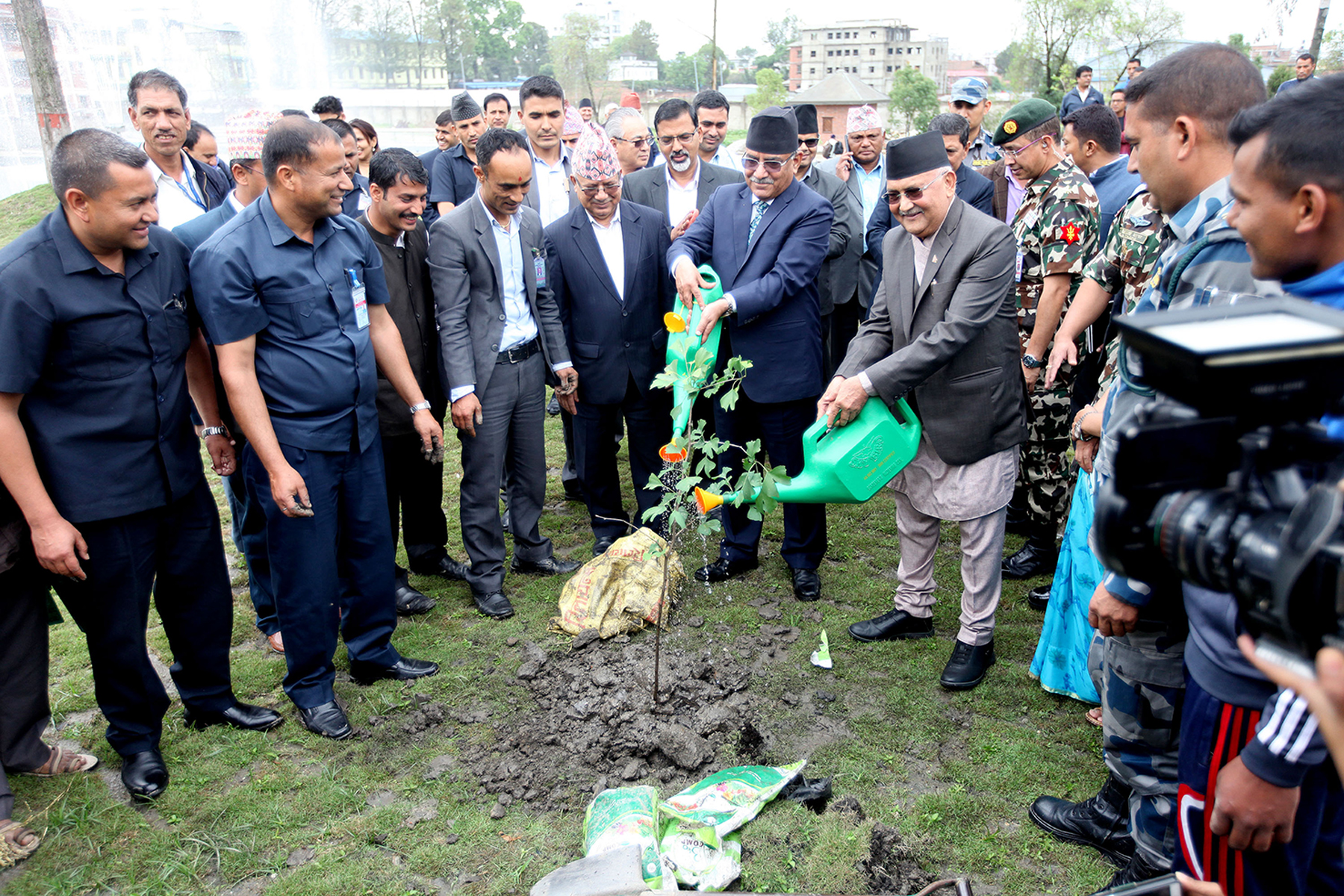
Prime Minister KP Sharma Oli and Pushpa Kamal Dahal water a sapling after officially announcing the unification of CPN-UML and CPN (Maoist Centre) at the City Hall. 


(From left) Prachanda does a red salute during a training for guerrilla commanders in Rukum in 2002. He addresses a mass assembly at the Khula Manch in Kathmandu. He speaks at one of the sessions at the Kantipur Conclave 2020.  

For those who thought that Prachanda had been buried, the election of Agni Sapkota as Speaker was an eye-opener. Dahal might appear to have transitioned almost completely to Pushpa Kamal, but an inkling of Prachanda remains within, only to come out when no one is really expecting it.

“Dahal is an opportunist and he speaks and acts in whatever manner that suits him,” said KC, the veteran communist leader. “It is due to his ambition and his personal interest. Prachanda manifests whenever he gets an opportunity.” 


https://tkpo.st/2HlNCq3

Comments

Popular posts from this blog

Political surprises of Balen led government

Prime Minister Balen Shah’s government has broken from decades of entrenched patronage politics  in its 100 days as called " honeymoon period ". Marked by rapid shifts, sweeping administrative overhauls, and bold foreign policy maneuvers, his tenure has generated several defining political surprises. Sweeping Governance & Administration Overhauls: A New Cabinet Standard : His government bypassed traditional veteran politicians, forming a 15-member cabinet that made national headlines for exclusively consisting of highly educated professionals. Dismantling Party Unions: In his first cabinet meeting, he shocked the civil service by pushing to abolish party-affiliated trade unions and aggressively streamlining federal ministries from 25 down to 17. The " 100-Point Agenda " : His governemnt immediately published a strict, delivery-focused 100-point reform agenda with measurable deadlines, aiming to completely digitize office management and track adminis...

A rare episode in the political history

Sudan Gurung , who is a Rastriya Swatantra Party (RSP) lawmaker, had earlier resigned from the position of Home Minister saying that he was stepping aside to ensure an impartial investigation and avoid any conflict of interest, has been reinstated on Tuesday, 9thJune 2026, after an official investigation into his finances found no wrongdoing, paving the way for his return to the office. A government-appointed investigation committee led by former High Court Judge Achyut Prasad Bhattarai submitted a 45-page report to Prime Minister Balendra (Balen) Shah at Singha Durbar on Friday, 5th June 2026 clearing him of corruption allegations and opening the door for his possible return to the post. Independent lawmaker Mahabir Pun, who was also the minister in the interim government of Sushila Karki , has also been appointed as the Minister for Science, Technology and Innovation along with Gurung. His appointment has created a rare episode in Nepal's political history. None of the in...

Strong government weak opposition

In the general elections held on March 5, 2026 the Rastriya Swatantra Party (RSP) won overwhelmingly 182 seats in the 275-member House of Representatives (HOR). Accordingly, a new majority government was formed under the leadership of RSP senior leader Balendra (Balen) Shah , without the support of any political party.    The RSP enjoys a comfortable majority government, whereas the oppositions are in weak positions in the national political history. The Nepali Congress (NC) has been reduced to a mere 38 seats. The CPN-UML holds 25, the Nepali Communist Party (NCP) 17, the Shram Sanskriti Party (SSP) 7, and the Rastriya Prajatantra Party (RPP) just 5. No other party managed to get even 10 percent of the total seats other than the NC. When the opposition is significantly weaker than a strong ruling party, the foundational checks and balances of a democratic system might be significantly weakened or break down. This has raised a fundamental question for the democratic republic ...